Why Client Accounting Systems Create Unnecessary Work
Client Accounting in Lettings: How It Actually Works
…and why most systems get it wrong
Most letting agents use a client accounting system every day.
They log in, review receipts, run payments, check statements and move on.
It works. It feels familiar. Terms like automated, integrated, same day and streamlined are common.
But very few agents are ever shown how client accounting actually works underneath the screen.
And once you understand that, you start to see why so much daily workload still exists.
Let’s start with the basics
When rent is paid, something very specific happens:
1. The tenant sends money to the client account
2. The bank receives the funds
At this point, the money is sitting in the bank.
But in many traditional systems, the client accounting platform does not yet fully know what has happened.
So the next step becomes critical.
3. A person or system has to retrieve that transaction data from the bank
This may happen through:
A manual download
A file import
A scheduled sync
An API feed processed later
4. That data is then pulled into the client accounting system
This is where a bridge is created between:
What happened in the bank
What the software now recognises
From there:
5. The transaction is matched to the correct tenant
6. It is reconciled
7. Payments are then prepared and scheduled to be sent out
And even then, there is usually another wait.
The bank still has to receive that payment run, process the instructions and release the funds.
Depending on timing, cut-off points and banking hours, that delay can be:
Minutes
Several hours
Or the next working day
That is the standard flow across many platforms.
And on paper, it sounds efficient.
The part rarely explained
Notice where the work begins.
Not when the tenant pays.
Not when the bank receives funds.
The real work often begins after that.
That is why many systems still need:
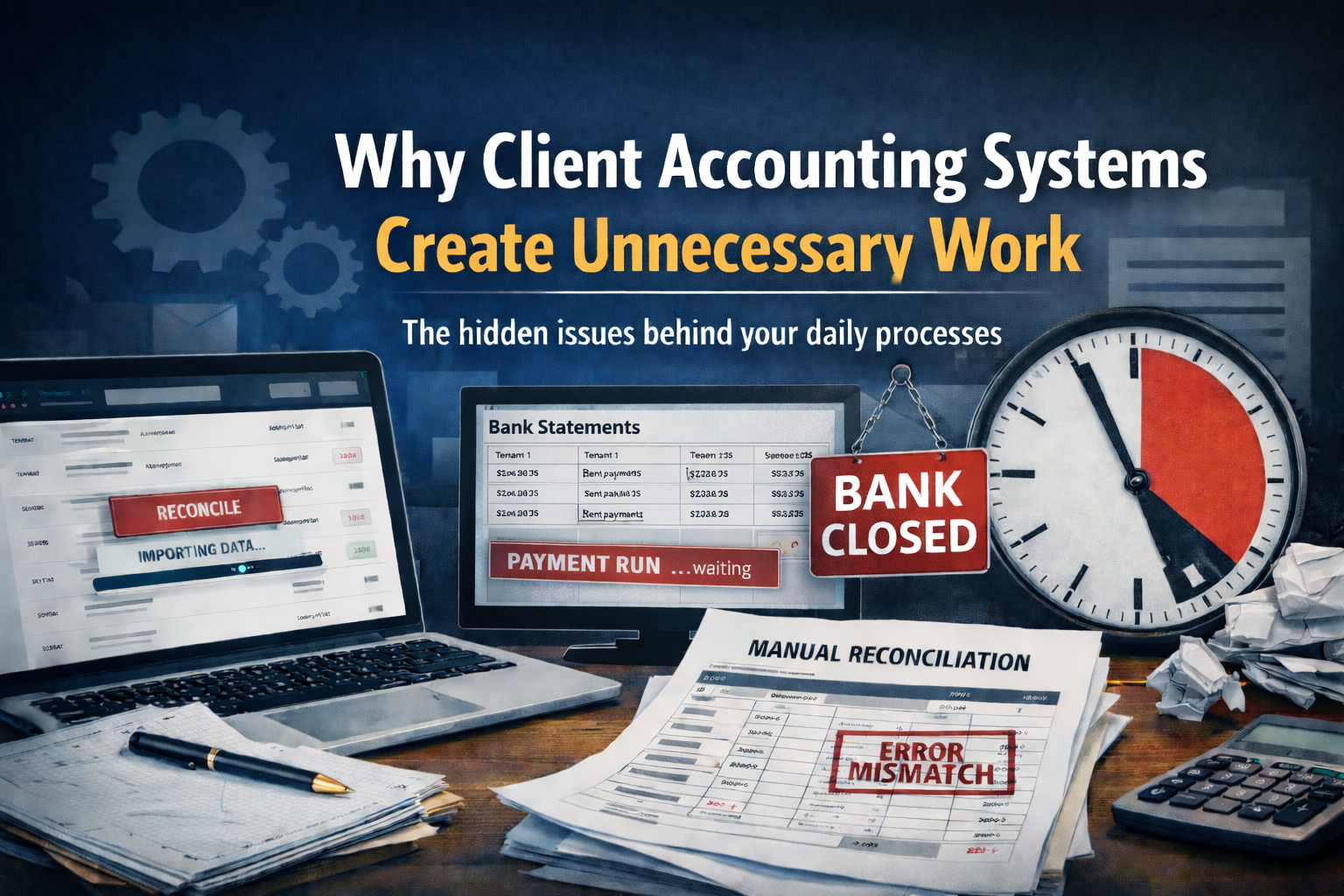
Reconciliation
Pending incoming payments
Unreconciled receipts
Payment runs
Status checks
Cut-off times
These are not signs of failure.
They are signs of how the model is built.
Why reconciliation is still a thing
Reconciliation is usually needed because the system still has to confirm:
Who paid
What they paid for
Whether the amount matches expectation
Where funds should go next
Even if this is heavily automated, it still means there is a process happening after receipt.
That is why users still encounter:
Exceptions
Mismatches
Reallocations
Delays before payout
It is not a people problem.
It is a sequence problem.
And as soon as you’ve finished, your system and the bank are out of sync again!
The timing issue most agents inherit
Many traditional platforms sit on top of the bank rather than operating at bank level.
So they are always responding to events that have already happened.
Which means everything else follows later:
Matching
Reconciliation
Payment preparation
Statements
Commission movement
Some systems do this faster than others.
But they are still processing after the fact.
What happens when you remove that gap
If the processing happens at the point funds arrive, the whole flow changes.
Instead of:
Money arrives → then the system works it out
You get:
Money arrives → already identified, allocated and prepared
That removes the lag between receipt and action.
Which means:
No daily reconciliation routine
No waiting for imports
No payment batching
No uncertainty around status
The work does not start later.
It is already done.
Why LettsPay is different
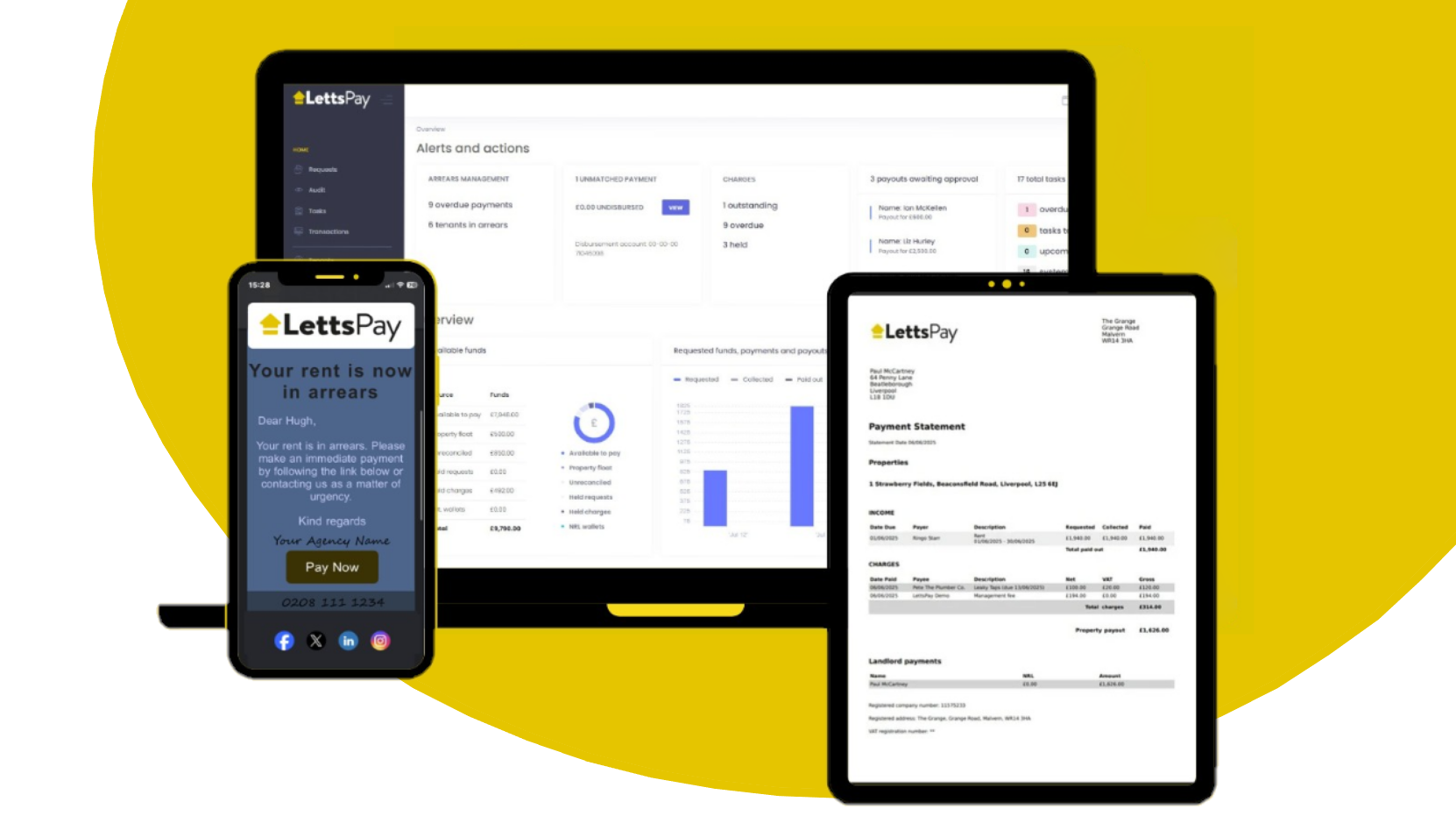
LettsPay is built around embedded banking and real time movement of funds.
That means rent can be:
Received as it lands
Allocated instantly
Prepared for landlord, contractor and fee payments immediately
Ready for approval 24/7
So by the time you log in, your day is already prepared.
We process it. You approve it.
Why this matters more than it sounds
At 20 or 30 properties, many systems can feel perfectly fine.
At 100, 300 or 1,000 properties, the model underneath starts to matter.
Because growth usually means:
More transactions
More exceptions
More payment pressure
More admin time
More staff cost to manage old workflows
That is when agents realise they are not scaling with automation.
They are scaling with more effort.
The practical difference day to day
Traditional processing often means:
Logging in to start the accounts workload
Checking pending receipts
Reviewing unreconciled items
Running payments later
LettsPay means:
Logging in to review what is already ready
Approving payments instantly
Seeing live balances
Drawing agency fees on demand when needed
Payroll due tomorrow? Supplier bill today?
Funds can be moved immediately. (Which is very different to being told “…and often the same day”)
Why many agents have never questioned it
Because the old process became normal.
So the industry accepted:
Reconciliation as routine
Payment runs as standard
Delays as unavoidable
“Same day” as impressive
Even though there is now a better model available.
The simple way to sense check your setup
Ask yourself:
Do we have pending or unreconciled receipts?
Do we wait for imports or syncs?
Do we run payments at certain times?
Do we spend time checking what has cleared before paying out?
If yes, the work is still starting after money arrives.
Final thought
Most client accounting systems are not broken.
They do exactly what they were designed to do.
The better question is whether they were designed for yesterday’s banking model.
Because once you see client accounting that truly works in real time, you stop asking:
“Does our system work?”
And start asking:
“Why does so much work still exist at all?”
Worth a quick sense check?
If you are still reconciling receipts, waiting on statuses or running payment batches, it is worth seeing what changes when those steps disappear.
No overhaul, or disruption to your front office systems.
Just real time rent processing, working directly at bank level.
We process it. You approve it. Everyone gets paid instantly.
Book a demo and see the difference that embedded banking can make for you, your landlords and teams.
We do the processing, you do the approving.